Computer Vision
Computer Vision development services
See defects, plates, people and products, automatically and at scale.
In one paragraph
Computer vision services build systems that detect, recognise and measure what appears in images and video: defects on a production line, licence plates at a gate, people and events on CCTV, products on shelves, findings in medical scans. Manufacturers, retailers, logistics operators and security teams use them to inspect, count and monitor continuously with accuracy that holds up in real conditions.
Why it pays off
- Continuous inspection and monitoring at machine speed
- Fewer defects, incidents and losses reaching customers
- Consistent decisions with recorded evidence
- Runs on cloud or edge hardware as required
- Models that keep working after launch
What's included
Computer Vision: everything in this service
Object detection & tracking
Detect, count and track objects in images and video streams for operations, safety and analytics.
Face recognition
Identity verification and access-control systems built with consent, privacy controls and liveness checks.
Image segmentation
Pixel-level segmentation for measurement, medical imaging, agriculture and industrial inspection.
Medical imaging AI
Decision-support models for radiology, pathology and dermatology imagery, developed with clinical validation in mind.
CCTV & smart surveillance analytics
Intrusion, loitering, PPE compliance, crowd and incident detection over existing camera networks.
Retail shelf analytics
Planogram compliance, out-of-stock detection and share-of-shelf from photos or fixed cameras.
Pose estimation
Human pose and movement analysis for safety, sports, fitness and ergonomics.
Drone & aerial vision
Inspection, mapping and counting from drone and satellite imagery for infrastructure, agriculture and construction.
OCR & document vision
Read text from scans, photos, labels and forms, including handwriting and low-quality captures.
Video analytics
Event detection, summarisation and search over recorded and live video.
Visual search
Search catalogues by image for e-commerce, parts and asset identification.
Use cases
Where it creates value
Production-line inspection
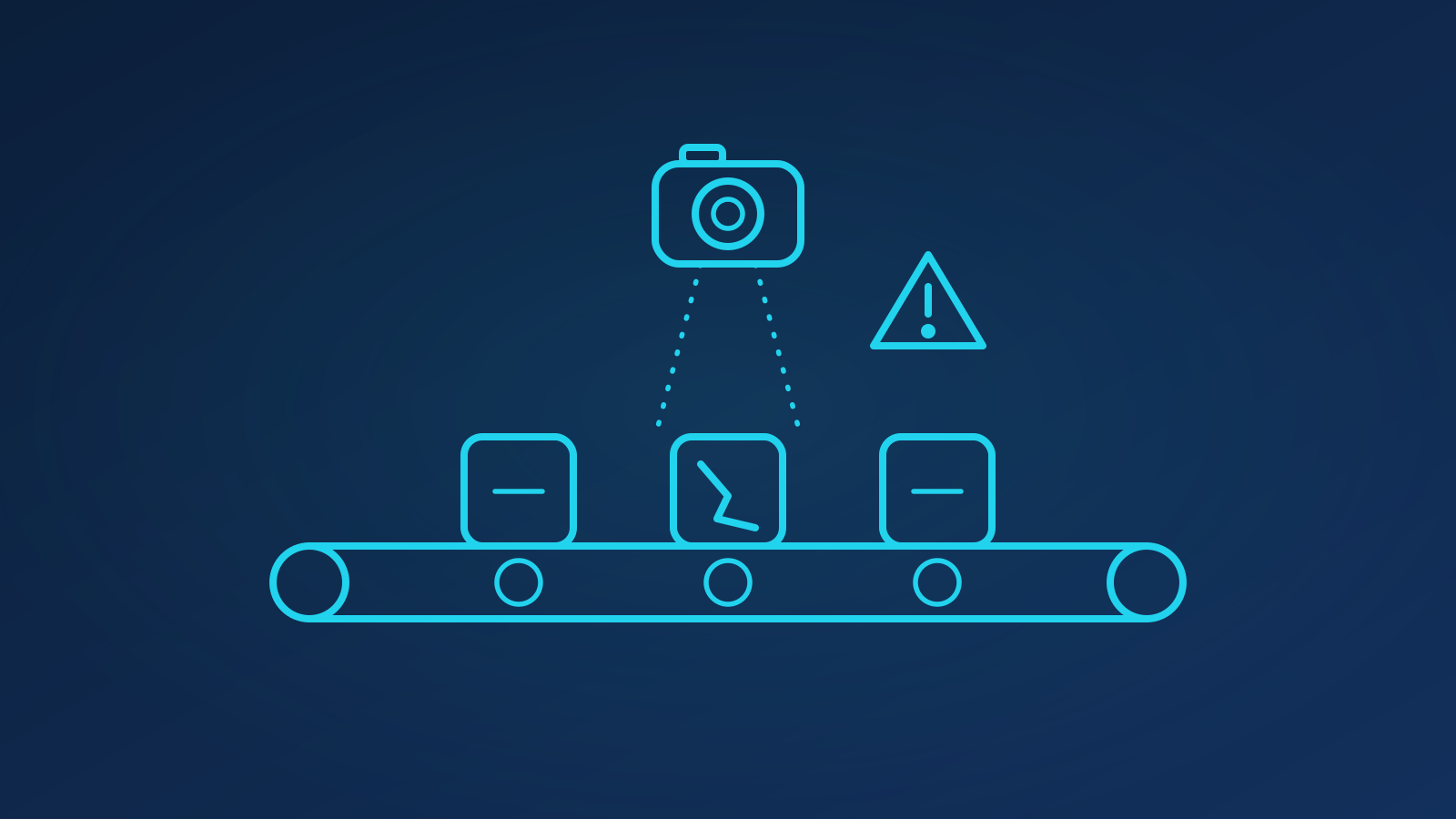
Catch defects in real time, reduce rework and returns, and record evidence for every unit.
Access and parking control
Recognise plates and faces to open gates, bill parking and manage fleets without manual checks.
Safety compliance monitoring
Detect missing PPE, restricted-zone entry and unsafe behaviour on existing cameras.
Shelf and inventory monitoring
Know what is out of stock or misplaced across stores from photos and cameras.
Document and label reading
Read shipping labels, meters, forms and IDs into your systems automatically.
How we deliver
How we deliver computer vision
- 01
Feasibility and data review
Assess camera setups, lighting, sample imagery and target accuracy; run a quick baseline before committing.
- 02
Data collection and labelling
Capture and annotate representative images, including rare cases, with tooling your team can continue.
- 03
Model training and validation
Train detection, segmentation or classification models and validate on held-out, real-condition data.
- 04
Deployment
Serve on cloud GPUs or edge devices such as Jetson with the throughput and latency your line or gate needs.
- 05
Monitoring and retraining
Track accuracy drift as conditions change and retrain on new examples on a schedule.
Related work
Outcomes, not demos.
Frequently asked
Computer Vision: questions we get
For detection tasks a few hundred well-labelled images per class is often enough for a first model thanks to pre-trained backbones; rare defect types need targeted collection. We start with what you have, run a baseline and tell you where more data is worth gathering. Synthetic augmentation (lighting, rotation, noise) stretches small datasets, but it never fully replaces real examples of the failure modes you care about.
Usually yes. Most IP cameras can stream to an edge box or server where the models run. We assess resolution, angle and lighting during feasibility and recommend adjustments only when they materially improve accuracy. For older analogue systems an inexpensive encoder gets the feed onto the network; we have yet to find a camera setup that could not be worked with.
Edge devices such as NVIDIA Jetson suit real-time inspection and sites with poor connectivity or privacy constraints; cloud suits batch processing and central analytics. Many deployments do inference at the edge and send events and thumbnails to the cloud. We often start in the cloud for speed of iteration and move to edge once the model and thresholds are stable and the hardware case is proven.
We design for the applicable law and your policy: consent and purpose limitation, on-device processing where possible, blurring of non-subjects, retention limits and access logs. Face recognition is only built where there is a lawful, documented basis. For most operational use cases (counting, safety, queue analytics) identity is not needed at all, and we design so it is never captured.
It depends on the task, image quality and how the classes are defined. We report precision and recall on your data from a baseline early in the project and set targets together, rather than quoting generic figures. As a rule, well-lit fixed-camera tasks with clear class definitions reach very high accuracy; ambiguous defects and variable outdoor scenes take more data and iteration.
Lighting, new products or camera moves can degrade accuracy. We monitor confidence and sample predictions, alert on drift and retrain on new examples; the retraining pipeline is part of the delivery. Your operators can flag wrong predictions from the interface, and those examples feed the next training round, so accuracy improves with use rather than decaying.
Ready to chart your AI course?
A free 30-minute consultation: we listen, ask hard questions and tell you honestly where AI will and won't help.