AI Agents · Automation · Strategy
AI agents vs automation: when to use which
Deterministic workflows and LLM agents solve different problems. Here is how to choose between them, and how to combine both without losing control.
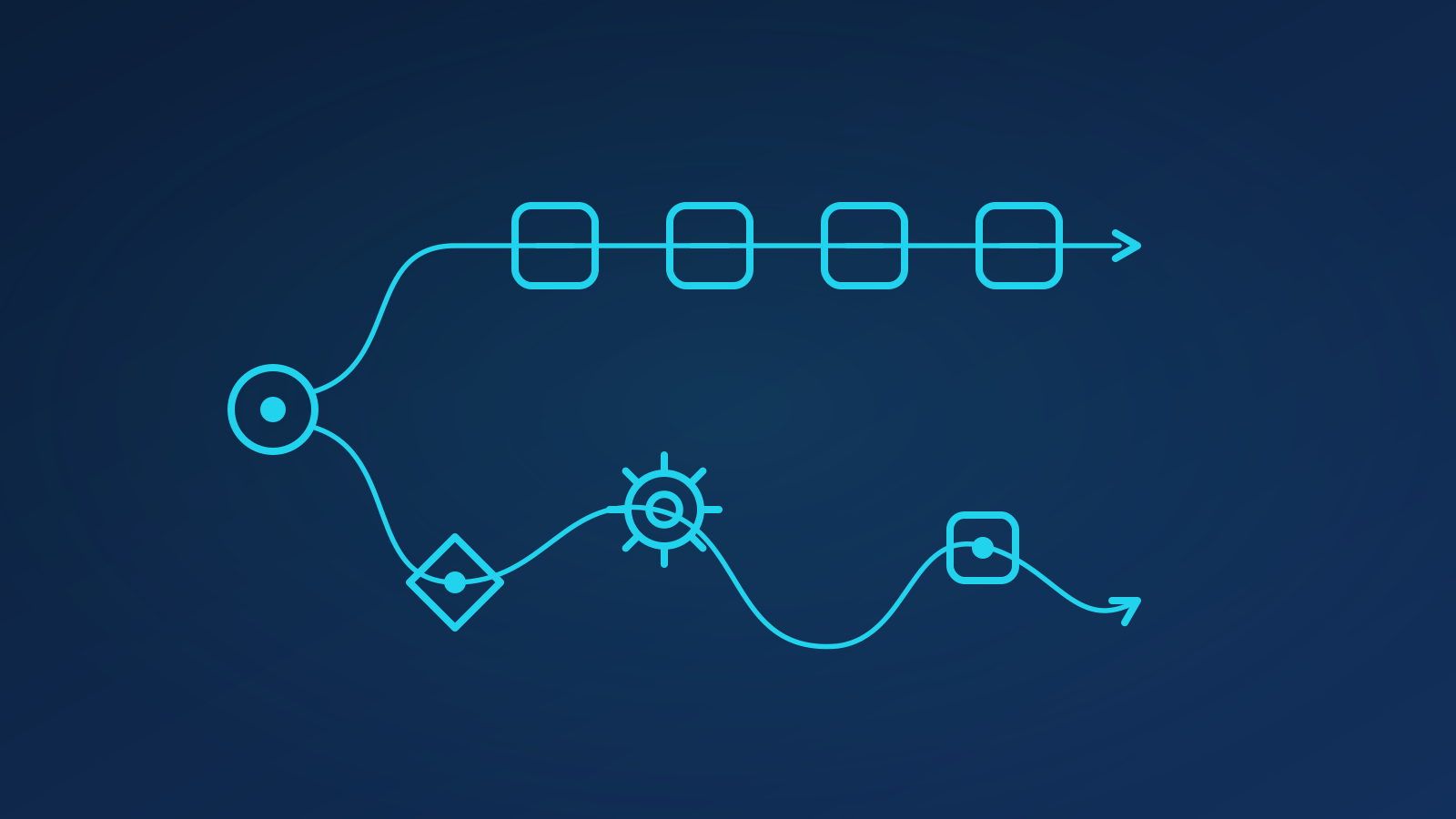
Use automation when the inputs are predictable and the steps can be written down in advance; use an AI agent when the inputs vary, the path is unclear until you see the data, and some judgement is required. Most real business processes need both: a deterministic workflow as the skeleton, with an agent handling the few steps where a rule would be too brittle.
TL;DR
- Automation (RPA, Zapier, n8n, scheduled scripts) executes a fixed sequence reliably and cheaply; it breaks when reality drifts from the script.
- LLM agents plan, call tools and adapt to messy inputs; they cost more per run and are harder to audit.
- Decide on four criteria: variability of inputs, need for judgement, cost of errors and auditability requirements.
- The best pattern is hybrid: a workflow engine owns the process, an agent owns the ambiguous steps, and humans own the exceptions.
What is the actual difference between an agent and automation?
Automation is a programme that does the same thing every time. A trigger fires, a defined series of steps runs, and if something unexpected happens the process errors out or routes to a person. Robotic process automation (RPA), integration platforms such as Zapier, Make and n8n, cron jobs and classic ETL pipelines all sit here. Their virtue is predictability: given the same input, you get the same output, and you can prove it.
An AI agent is a language model given a goal, a set of tools and permission to decide what to do next. It reads the situation, chooses a tool, looks at the result and repeats until it believes the goal is met. That loop is what lets it cope with an invoice in an unfamiliar layout, a customer email that mixes three requests, or a research task where the next step depends on what the last step found.
The trade is direct. Automation is cheap, fast and auditable but brittle. Agents are flexible but slower, more expensive per run and probabilistic, meaning two runs on the same input can differ. Neither is better; they are tools for different shapes of problem, and our AI agents and AI automation teams are usually staffed on the same engagement for that reason.
When should you use plain automation?
Reach for deterministic automation first whenever the process passes this test: could a careful new hire follow a written checklist and get it right every time? If yes, you do not need a model reasoning about it.
Typical fits:
- Moving records between systems when a status changes
- Sending templated notifications and reminders
- Generating scheduled reports from structured data
- Validating and enriching form submissions against known rules
- Approvals with clear thresholds
The cost of getting this wrong is high in the other direction too. We regularly meet teams who wrapped an LLM around a task that a lookup table would have handled, and are now paying per token, waiting seconds per record and debugging non-deterministic output. If the rule can be written down, write it down.
When do you actually need an agent?
An agent earns its cost when at least one of these is true:
- Inputs vary in form. Documents, emails, voice transcripts and web pages arrive in shapes you cannot enumerate in advance.
- The next step depends on the content. Triaging a support ticket, deciding which of five systems holds the answer, or drafting a reply that references the right policy all require reading first and acting second.
- The task is a small investigation. Reconcile these two ledgers and explain the differences; find the supplier records related to this complaint; summarise what changed in this contract.
- You want natural-language control. Staff describe what they need and the agent translates it into tool calls, rather than someone building a new workflow for each request.
Even then, constrain the agent. Give it a small number of well-typed tools, cap the number of steps, require confirmation for anything that writes to a system of record, and log every tool call with its inputs and outputs. The goal is bounded autonomy, not a free-roaming assistant.
How do you decide? Four criteria
| Criterion | Favours automation | Favours an agent |
|---|---|---|
| Variability of inputs | Structured, predictable, enumerable | Unstructured, novel, mixed formats |
| Need for judgement | Rules cover every case | Cases require reading and interpretation |
| Cost of an error | High, and errors must be impossible by construction | Moderate, and a human review step is acceptable |
| Auditability | Every step must be reproducible | Reasoning traces and logs are sufficient |
| Volume and unit cost | Very high volume, tight margins | Lower volume, high value per case |
Score the process honestly on each row. A process that lands in the left column on three or more rows is an automation project, whatever the vendor pitch says. One that lands on the right for variability and judgement, but on the left for cost of error, is the classic case for a hybrid with a human check.
What does the hybrid pattern look like in practice?
The design we return to most often is an automation skeleton with agent steps.
The workflow engine, whether n8n, Temporal, a queue-based service or an RPA platform, owns the process: it triggers on events, holds state, enforces the order of steps, retries failures and records everything. At the points where a rule would be brittle, it calls an agent as one step among many, passes it a tightly scoped task, and receives a structured result back.
A worked example from the kind of finance-operations engagement we see often:
- Invoice arrives by email; the workflow stores it and creates a case (automation).
- An agent extracts fields, matches the supplier and purchase order, and flags anomalies with a confidence score (agent).
- Above a confidence threshold and below a value limit, the workflow posts to the accounting system (automation).
- Everything else routes to a person with the agent's extraction and reasoning attached (human).
- Human corrections feed an evaluation set that is re-run before every prompt or model change (MLOps).
This gives you the auditability of a workflow, the flexibility of a model where it matters and a clear place for humans to intervene. It also keeps the agent's blast radius small: it never decides whether to pay, only what it thinks the invoice says. Connecting these pieces to your existing systems is where our AI integration work usually sits.
Key takeaways
- If the steps can be written down and inputs are predictable, use deterministic automation; it is cheaper, faster and provable.
- Use an agent where inputs vary, the path depends on content, and judgement is needed, and constrain it with typed tools, step limits and logging.
- Decide with four criteria: variability, judgement, cost of error and auditability.
- The hybrid pattern, a workflow skeleton with agent steps and human exceptions, covers most real processes.
- Keep an evaluation set from human corrections so you can change models and prompts safely.
If you have a process and are unsure which side of the line it sits on, talk to us; a short mapping session usually settles it.
FAQ
Are AI agents replacing RPA and workflow tools?
No. They are being embedded inside them. Workflow platforms are adding LLM steps precisely because the deterministic engine remains the right place to hold state, enforce order and retry failures. What agents replace is the long tail of brittle rules and manual exception handling that RPA never coped with well. Expect fewer hand-written parsers, not fewer workflows.
How do we keep an agent from doing something it should not?
Design for bounded autonomy. Give it a short list of tools with strict input schemas, mark write actions as requiring confirmation, cap the number of steps per run, and run it inside a workflow that decides what happens with its output. Log every tool call. Most importantly, keep an evaluation set of real cases and check behaviour against it before every change to the prompt or model.
Is an agent always more expensive than automation?
Per run, almost always: model inference costs more than a rule and takes longer. Per outcome, not necessarily. If a process currently needs a person to handle every exception, an agent that resolves most of them can be far cheaper overall. The right comparison is total cost per completed case, including human time, against the same figure for the current process.

Written by
William Ali · Founder & AI Specialist
Leads strategy and solution design. Has shipped conversational AI, agent and analytics systems for clients across e-commerce, SaaS, healthcare and finance since founding AIYatch in 2019.
About the team →Related services

Ready to chart your AI course?
A free 30-minute consultation: we listen, ask hard questions and tell you honestly where AI will and won't help.